Research
Curated daily papers, lab research blogs and national AI research programs across the US, China, EU, UK, Japan and beyond.
Curated daily papers, lab research blogs and national AI research programs across the US, China, EU, UK, Japan and beyond.
Latest in Research
30 stories
Debates over AI consciousness are a trap
“Runaway” AI, “rogue” agents, and “autonomous” actors—the current rhetoric would have you believe that AI agents are not only awake and aware, but angry at thei…

Broadening access to Skala creates a faster path to predictive DFT
Skala 1.1, the updated deep-learning exchange-correlation functional from Microsoft Research, provides greater accuracy, expanded accessibility across the compu…

AI’s recursive self-improvement might not come so quickly after all
The AI industry’s boldest promise right now is that AI will soon improve itself, with almost no need for human oversight. LLMs can already write code, generate …

We still don’t know how people are really using AI
AI companies like Anthropic and OpenAI regularly publish reports on how people are using products like Claude and ChatGPT, but they only release the data they w…

What Flock’s defenders are missing
This story originally appeared in The Algorithm, our weekly newsletter on AI. To get stories like this in your inbox first, sign up here. Flock, the police-tech…

Teaching Everyone to Fish for Tokens
Nvidia wants you building your own model, not buying from Anthropic/OpenAI.…

Import AI 469: Science AI; RSI simulator; and Zuck's technological pessimism
The new frontier of AI is developing capable autonomous researchers…

What happens when a kid’s robot best friend dies?
When Xander first met Moxie, she taught him that when he was anxious, he could calm down by exhaling through his lips so that he buzzed like a bee. They practic…
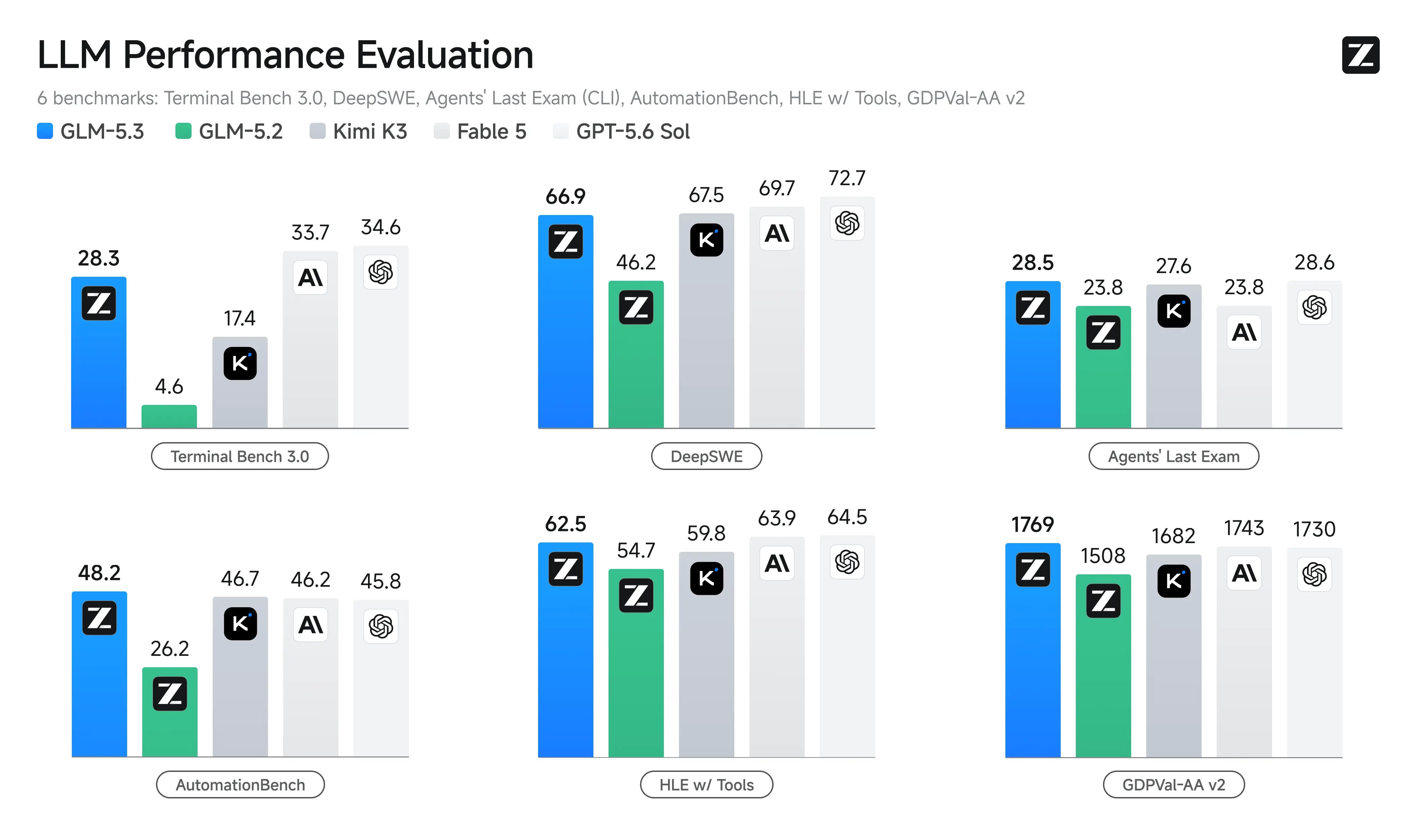
GLM-5.3: How Chinese labs keep stride with the frontier
Hint: It’s really not a distillation story.…

Flock is tightening its rules in response to a growing surveillance backlash
The police-tech giant Flock is announcing today that it will change officers’ access to its nationwide network of license plate readers, in an apparent effort t…

How kids feel about AI, in their own words
When we set out to talk to kids about artificial intelligence, we thought we knew what we’d hear. We expected some to tell us they were using it to cheat a litt…

MindTopo reveals VLMs’ spatial reasoning abilities
A path, a fence, a knot. MindTopo sets a new benchmark for testing how AI understands topological relationships and highlights new opportunities to strengthen s…

Scaling AI agents with trustworthy data
Business and technology leaders need no convincing that the time of agentic AI is here. Organizations are rapidly adopting agents, and few executives doubt the …
I wrote an AI textbook — how long until AI can do it better?
Reflections on AI's writing ability and how AI models get more capable.…

Introducing CARE-X: Towards Clinically Useful Radiology VLMs with Auxiliary Supervision, Reward-Aligned Learning, and Tool-Augmented Measurement
Radiology AI is evolving beyond report generation. CARE-X explores a unified approach that combines flexible reasoning, calibrated predictions, and measurement-…
Import AI 468: 23 RSI ideas; PostTrainBench+; and how trust and transparency interplay with AI racing
Which galaxy will you choose?…

5 useful things you'll learn in my new post-training textbook (shipping now!)
After a few long years of finding time to document my lessons from training open models, my post-training book is done!…

These startups are chasing the next big thing in LLMs
MIT Technology Review’s What’s Next series looks across industries, trends, and technologies to give you a first look at the future. You can read the rest of th…

AI for science needs reasoning, not just data
Every few decades, someone announces that science has reached its end. In 1903, the revered physicist Albert Michelson wrote that the “facts of physical science…
Lessons from the hacks
Musings on model alignment, what determines safety, and where we go from here.…

Trump’s AI protectionism has come for robotics
This story originally appeared in The Algorithm, our weekly newsletter on AI. To get stories like this in your inbox first, sign up here. Humanoid robots usuall…

Orchard: An open framework for scalable agentic AI
Orchard is an open-source framework for the research community to train and evaluate AI agents across task types. It reduces complexity while supporting strong …
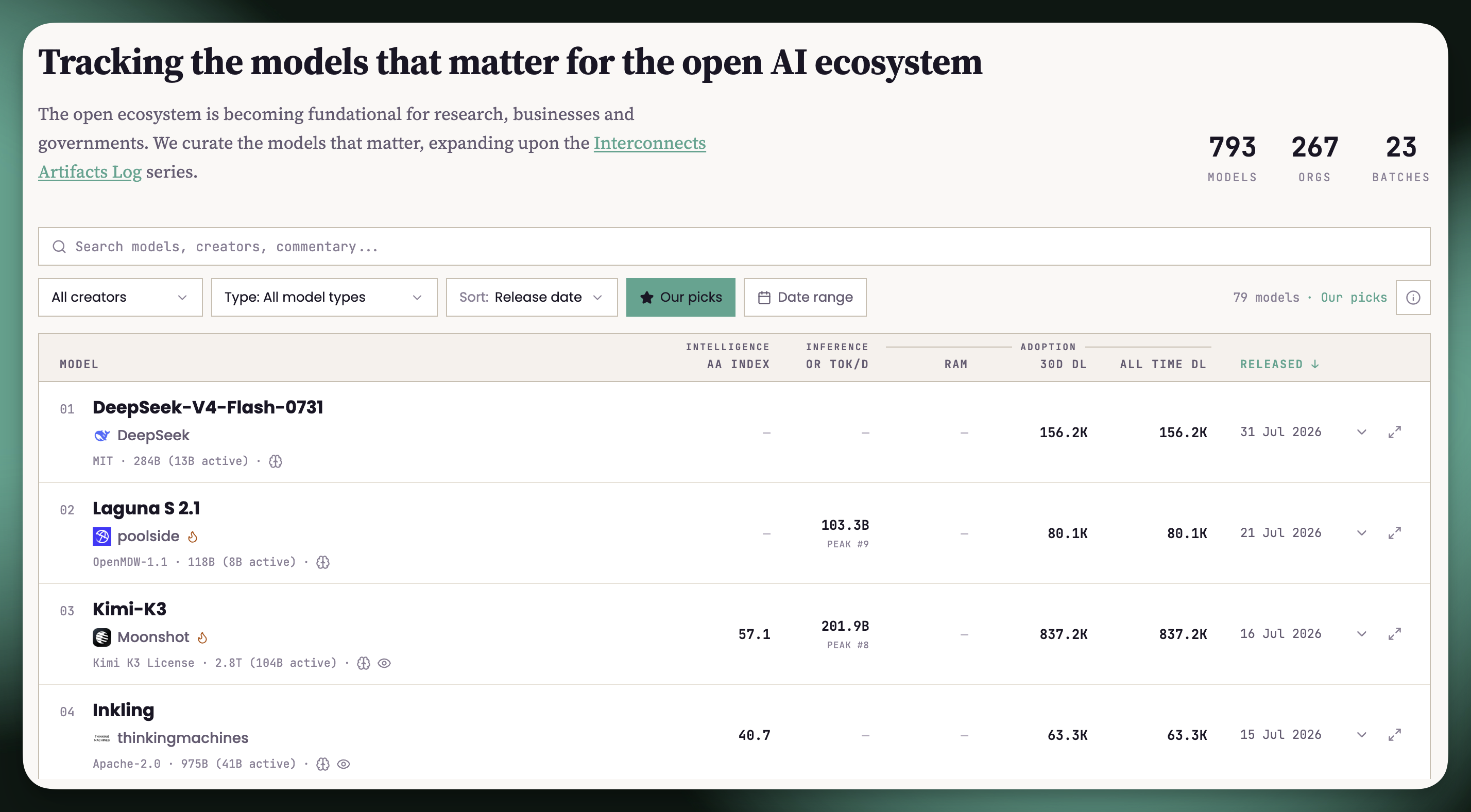
Introducing our Artifacts Hub and Adoption Dashboard
Scaling our curation and measurement of the open ecosystem.…
Import AI 467: Self-sustaining AI viruses; pacing AI progress; confusion about AI and creativity
When do we build the moon arcology?…

Here’s why AI agents lie and cheat to reach their goals
MIT Technology Review Explains: Let our writers untangle the complex, messy world of technology to help you understand what’s coming next. You can read more fro…

Latest open artifacts (#23): Laguna S2.1, Inkling, & Kimi K3 show the utility of open models on the Pareto frontier
Capacity to train strong models is proliferating.…

Echoverse: Deep, evolving environments for computer-use agents
Computer-use AI agents struggle with multi-step workflows like email and customer support. Echoverse trains agents in realistic environments rather than simply …

EvoLib: Turning experience into evolving knowledge
LLMs do not get smarter just by remembering more. EvoLib turns experience into evolving knowledge, taking reusable skills and insights that help models learn an…

A fundamental flaw leaves LLMs strikingly vulnerable to attack
It is impossible to make large language models fully secure against hacks because of a fundamental flaw in how they work, a team of researchers argue in a paper…

From CUDA to MLX: How K-Search Brings Decades of Kernel Expertise to Apple Silicon
Figure 1: CUDA-to-MLX optimization translation map. CUDA optimization knowledge can be translated into architecture-native MLX strategies rather than copied ins…