Investing in Pangram to Stop AI Slop on the Internet
Why it’s critical to prevent polluting the internet This is a seminal moment for human history. Stop and think about it. We have invented a machine that now creates information indistinguishable from that of humans. A majority of the content created on the internet (and even off the internet) is created by AI, as well […] The post Investing in Pangram to Stop AI Slop on the Internet appeared first on Menlo Ventures.
Overview
Why it’s critical to prevent polluting the internet
This is a seminal moment for human history. Stop and think about it. We have invented a machine that now creates information indistinguishable from that of humans.
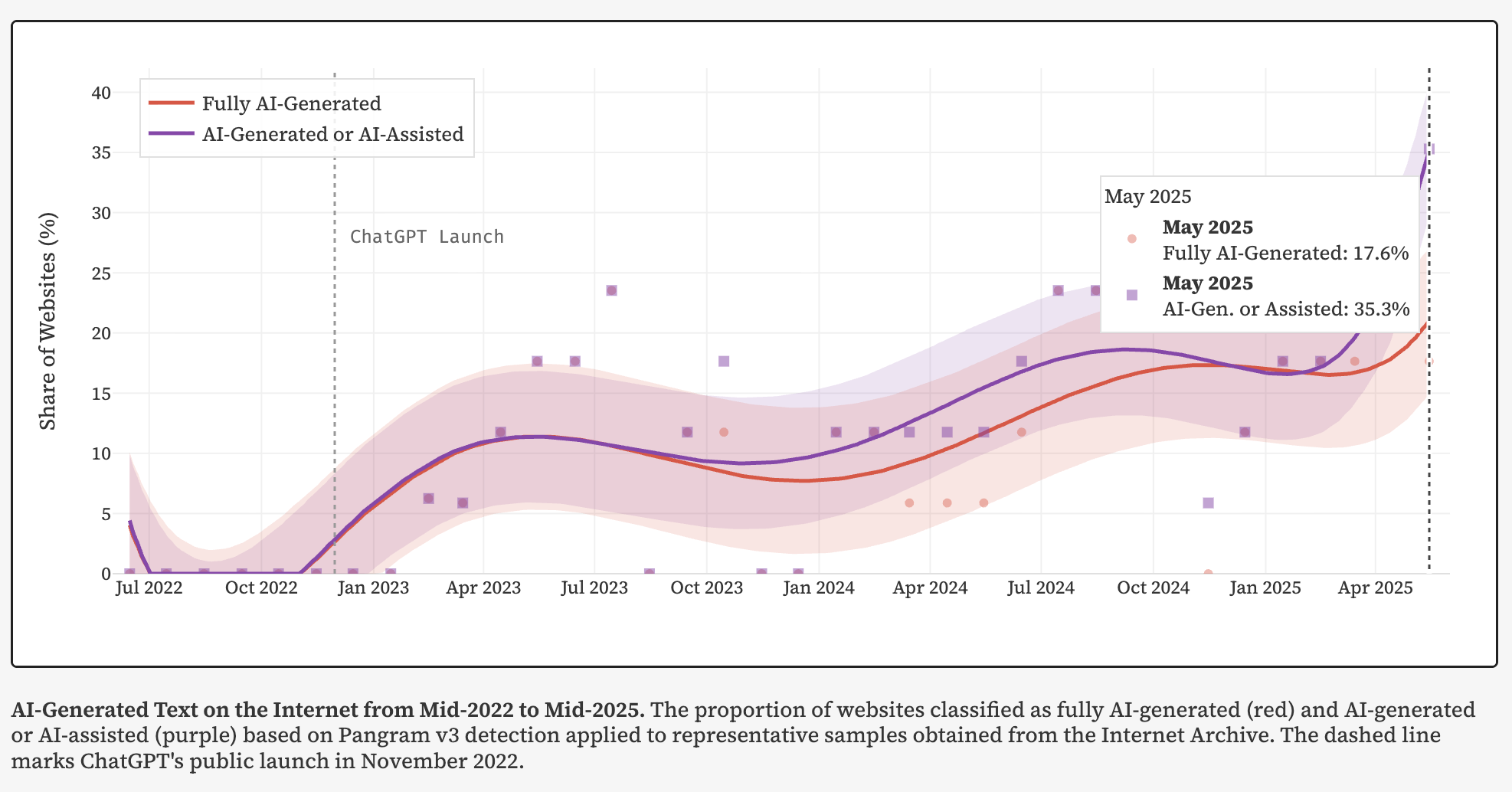
A majority of the content created on the internet (and even off the internet) is created by AI, as well as 35% of all new websites. In fact, 33% of the top articles on Substack and nine of the top 25 categories had >10% written by AI. It’s not just generic internet content; key parts of the global social order’s writing is written by AI. The share of federal civil complaints that were AI-generated has gone from 0 to 18% in the last four years. The share of peer reviews from machine learning conference ICLR was 21%, as well as 12.4% of life science research papers from BioArxiv, 19% of computer science papers, 10% of physics papers, and even 9% of all newspapers.
We know not all AI-generated content is necessarily bad, but as Aphyr’s recent essay, “The Future of Everything is Lies, I Guess,” states plainly:
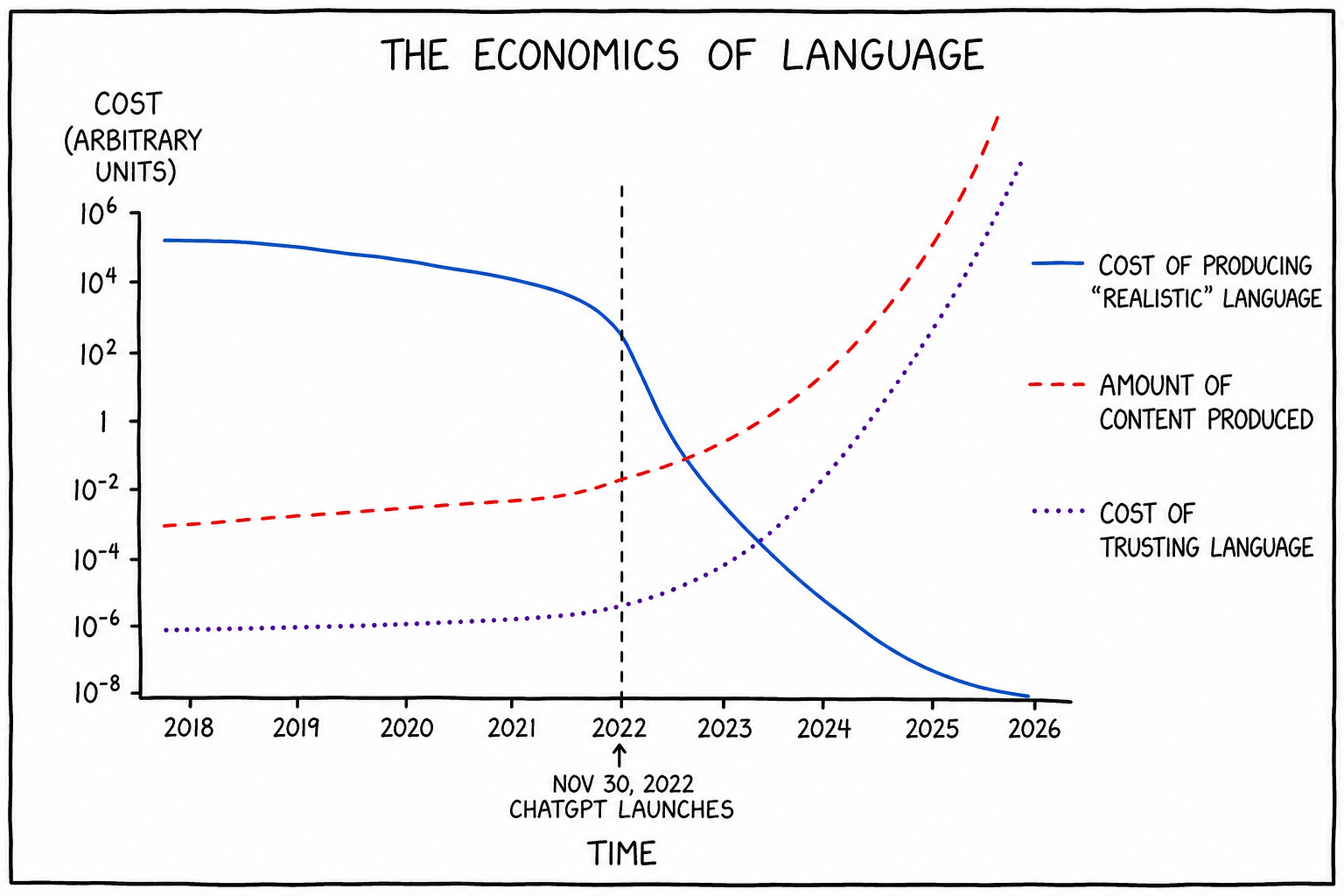
As the cost of producing language collapses to zero, the cost of trusting language goes to infinity.”
This creates an information ecosystem where audiences believe everything and nothing all at once, which is not an environment where serious civic, scientific, or commercial culture can survive. It ends up polluting the internet with cheap, easily producible, and often hallucinated “slop.” We must stop polluting the internet with AI slop.
Why we need to do better than we do today
Someone has to restore the asymmetry. Now, AI detectors are not new. The problem is, most of them cannot be trusted: Multiple competing AI detectors thought the Declaration of Independence was written by AI (many have written about the uselessness of AI detectors)! Detecting whether a certain text is AI is a difficult problem. Ultimately, if you type out text that sounds exactly like an LLM would write it, it might pass the AI detector.
We backed Pangram because they are the only AI detector that survives independent academic scrutiny as the best AI detector with a one in 10,000 false-positive rate and a <0.5% false negative rate, too (on passages >50 words), as audited by the University of Chicago’s Becker Friedman Institute. Without even retraining the model, it is able to maintain its performance on new iterations of models (Claude Opus 4.7, GPT 5.5) and entirely new model families (Meta Muse Spark). In fact, if you use mechanistic interpretability to analyze the model weights, the model can distinguish between text generated by different models! This is why the Internet Archive chose Pangram over all the competitors they evaluated and why researchers consistently prefer Pangram to measure AI’s prevalence in various sources. Pangram’s users range from companies with the biggest sources of content, like Quora, Google Classroom and even the viral Substack native integration, to more niche products that care deeply about quality, like Hacker News and LessWrong, to their 200,000+ users (with zero paid marketing)!
Details
The future of AI-generated content
There are innumerable benefits to writing with AI. It corrects copy, helps reframe reasoning, and coalesces interesting insights into persuasive prose. But if you put that text behind a human’s social identity, it breaks the social contract. A reader does not know if you wrote the draft with your original thoughts and had AI rephrase it or if you entirely generated it with one prompt with no input. That breaks the trust protocol of the internet. Did this person actually write this themselves? If there’s even a small probability they spent zero effort to write it, why should I spend effort reading it? It’s like replacing bread with cheap cornstarch and saying, “But hey, you couldn’t tell the difference, so it’s just as good as bread!” The cost of trust goes to infinity. Even if the writing is fantastic, a user deserves to know if AI wrote it or a human.
What’s next for Pangram
Pangram helps preserve the trust contract for language. And language is just step one. Next is images, videos, and other modalities. AI-generated images and videos are the attack vectors for fake news dissemination throughout the internet. The 23rd most popular AI subreddit, r/IsItAI, has 250,000 weekly users wondering if certain images and videos are real. This is a frighteningly big market.
Max Spero and Bradley Emi met freshman year in a dorm room at Stanford—two physics and CS students teaching machines how to learn. They eventually went on to both become AI researchers—one who built self-driving cars at Nuro and the other who worked on the early vision models at Tesla Autopilot with Andrej Karpathy. I first began chatting with Max on X after noticing that Pangram did an incredible job identifying “slop posters.” Over the next few months, when I visited their offices in Brooklyn, New York, I was just blown away by Max and Bradley’s dedication to the mission. They aren’t doing this because they wanted to be founders and this is a good business; they’re doing it because it simply had to be done. For example, despite numerous requests from users to create a humanizer, a program that makes AI text less detectable, Max and Bradley simply refused. It is compatible with the mission. These guys could have gone and worked at any AI lab in the world, yet they chose to work on one of the most important problems in this new post-AI world. That is why we at Menlo Ventures are proud to lead Pangram’s Seed as part of the Anthology Fund!
If you, too, are interested in preventing AI slop pollution on the internet, Pangram is hiring!
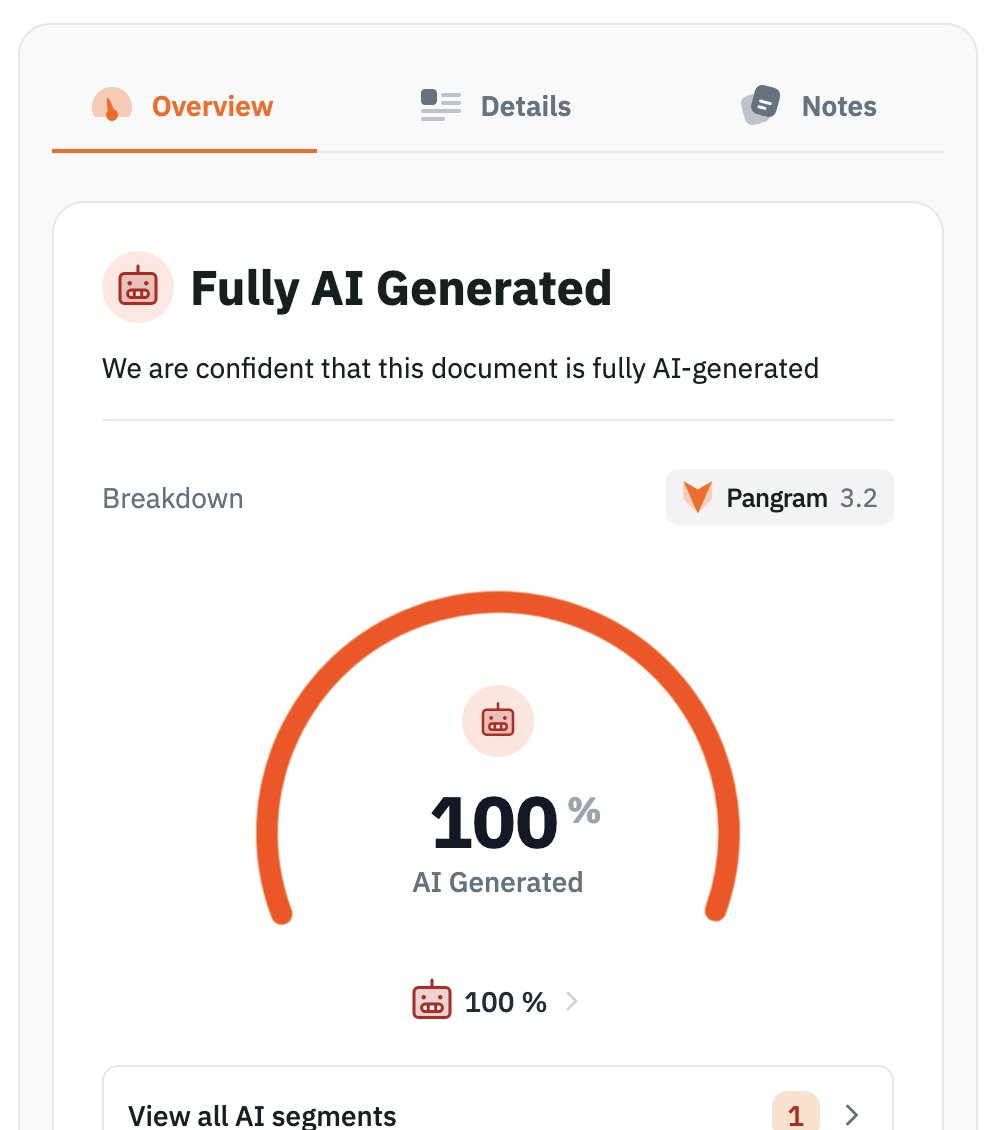
[This post is 100% human-written, as verified by Pangram.]
The post Investing in Pangram to Stop AI Slop on the Internet appeared first on Menlo Ventures.
Source
Originally published at menlovc.com.
