ChinAI #358: Around the Horn (25th episode)
Greetings from a world where…

Overview
Greetings from a world where…
summer beckons
…As always, the searchable archive of all past issues is here. Please please subscribe here to support ChinAI under a Guardian/Wikipedia-style tipping model (everyone gets the same content but those who can pay support access for all AND compensation for awesome ChinAI contributors).
Around the Horn (25th episode)
I miss Woody Paige’s blackboard: let’s go back Around the Horn!

This is our 25th roundup of articles on China’s AI ecosystem. For new readers, here’s how it works (see ChinAI #350 for the previous edition):
I give short previews of ten articles that caught my eye during a scan through my usual sources (all published within the past week or so). The title for each preview links to the original article in Chinese.
Readers vote on next week’s feature translation by replying to the email and/or commenting on the post with the number of your preferred article. *I’ll give some added weight to votes from those of you who support ChinAI through a paid subscription.
The main idea is that any of these 10 links would have made for a great feature translation this week — like the movie soundtrack for Boyhood, there are no skips!
1) 10,000-character deep dive | ModelBest: at the limits of efficiency, continuously traversing the AGI cycles
Summary: I’ve always been curious about the Chinese AI startup ModelBest [面壁智能]. This deep dive explores some of the themes covered in ChinAI #296 and provides some updates on ModelBest’s distinct technical path.
Source: Hushuo Chengli [胡说成理] - platform founded by Hu Zhe [胡喆], an author of books on Chinese internet history and former deputy editor-in-chief of Leiphone.
2) Now it’s your turn to foot the bill for (ByteDance’s) Doubao
On May 4, the AI super-app Doubao quietly added three tiers of paid subscriptions on top of its free version, which triggered an internet firestorm. One interesting nugget from this article: among the its 345 million monthly active users, the vast majority are either students or middle-age and older who mainly use the app for casual chatting and information retrieval (which may not match the demands of the new paid productivity features).
Source: 虎嗅 (Huxiu) — well-known platform that shares user-generated content but also publishes their own pieces on China’s science and technology ecosystem.
3) Young AI professionals face “debt collection” from former employers
Summary: To prevent AI talent from being poached, Chinese companies have taken extreme measures with their non-compete agreements. This article profiles many young professionals who signed non-competes without reading the fine print and now find themselves facing legal claims with millions in damages and psychological distress.
Source: 人物 (renwu) — magazine that covers human-interest stories. A previous issue translated their longform investigation of the algorithmic pressures faced by Chinese delivery drivers.
4) Release of Results for the AI Safety Benchmark (Q1 2026)
Summary: This is one of the Chinese AI safety benchmarks that I’ve been following closely. CAICT released its first batch of 2026 results, including some tests of “loss-of-control” behavior.
Source: CAICT AI安全治理 (CAICT AI Safety/Security Governance) — the government-affiliated think tank’s portal dedicated AI safety/security issues
5) AI PPT, this time, you really don’t need revisions
Summary: For a long time, industry circles viewed AI-generated PPT as a fake or overestimated demand, given the need for extensive revisions. This QbitAI product trial tests that thesis with iFlytek Zhiwen’s AI-powered PPT tool Vision Agent.
Source: 量子位 (QbitAI) — news portal that regularly covers AI issues, similar to Leiphone and xinzhiyuan. Lately, QbitAI has been publishing longer reports more frequently.
6) “Peeling lobsters online, eating lobsters offline” ignites Wuhan
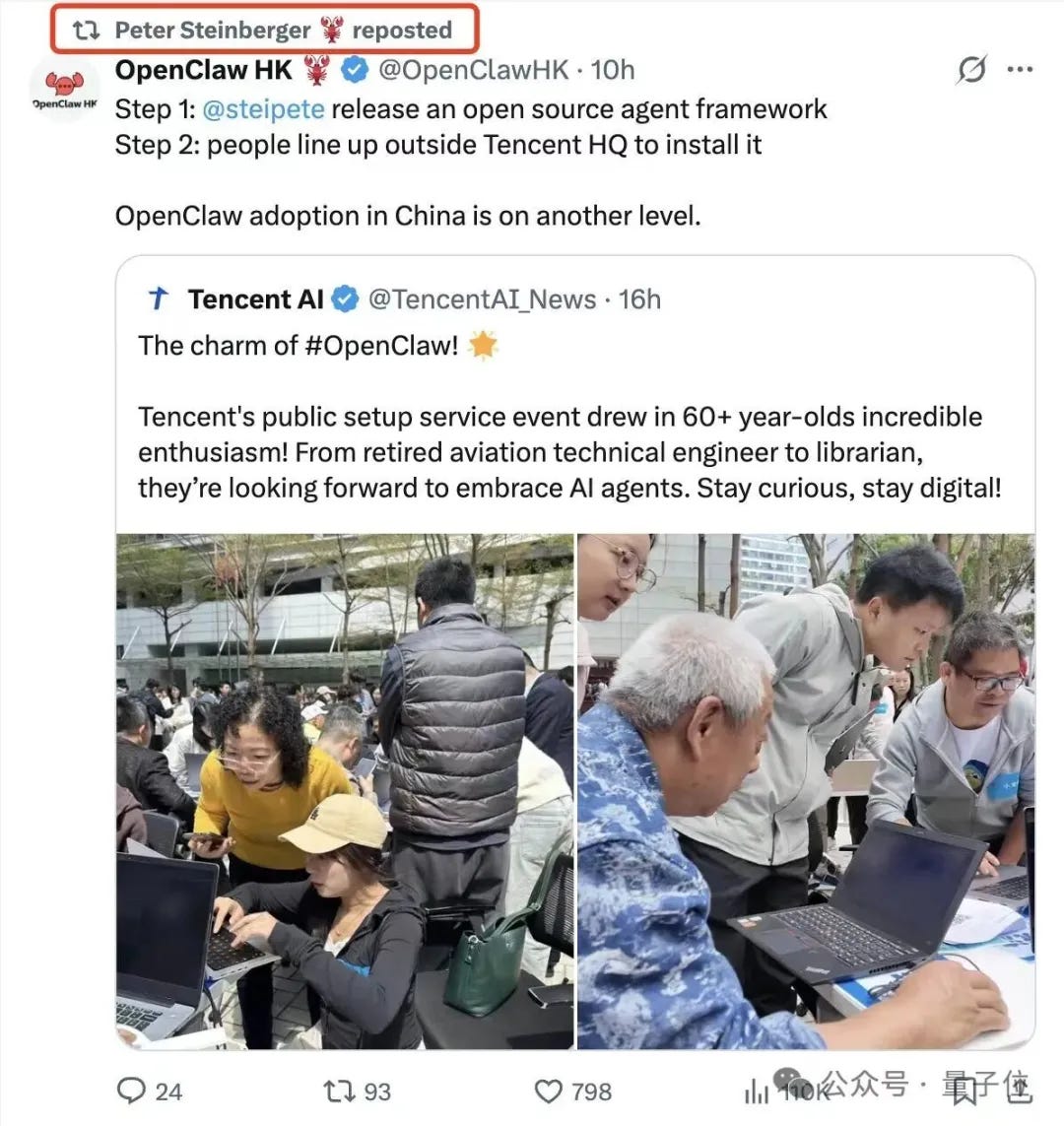
Summary: This article covers Wuhan’s initiative to drive the adoption of AI agents (note: lobster is a reference to OpenClaw). In the past, I’ve noted a trend in OpenClaw’s China community, in which Tencent and other big companies set up offline “booths” to help people deploy open-source agents.
Details
Source: China Software Developer Network (CSDN) — the largest software developer community in China, which provides IT news coverage and hosts code
7) Chinese Universities Discontinue Over 5,000 Majors in Five Years
Summary: Remember when there was so much hype about China establishing an AI major? This piece explores the trend in Chinese universities suspending various majors, including student complaints about a previously-hyped e-commerce major.
Recommended by Source: 知识分子 (The Intellectual) — a platform that covers the state of science in China, founded by Chinese and Chinese-American scientists.
8) Understanding China through DeepSeek’s Triple-Jump Valuation
Summary: DeepSeek’s valuation jumped three times in under 20 days; from $10 billion in mid-April to $20 billion in late April, then to $51.5 billion this past week. Yu theorizes why DeepSeek’s valuation jumped, and what that says about China’s AI ecosystem.
Source: Shuzi Lichang (数字力场) — Started following this account back in 2021, but I haven’t browsed them that closely. This article is by Zongming She, a former deputy editor of the commentary section in The Beijing News.
9: Leiphone Detectives Vol. 7 [AI情报局]
Summary: Leiphone has a new series that collects interesting industry rumors. This week’s edition includes: 1) complaints from an employee at a major internet firm about their department burning the budget on token costs in order to deliver real-time, interactive PPTs; 2) a major company’s autonomous driving division experienced a disastrous failure during early stages of mass production, with blame going toward the division’s head who had no experience prior to appointment.
Source: Leiphone Detectives series [AI情报局] - for a translation of one of their previous issues on industry rumors, see ChinAI #354.
10: People’s Daily Commentary: What Signal Does the Halting of the Manus Acquisition Send?
Summary: This piece gives you a sense of how official platforms are trying to spin China’s blocking of the Manus acquisition. Interestingly, it holds up Zhipu and MiniMax as examples of continued openness to foreign investment.
Source: People’s Daily Commentary [人民锐评] - online commentary platform of official CCP newspaper.
Thank you for reading and engaging.
These are Jeff Ding’s (sometimes) weekly translations of Chinese-language musings on AI and related topics. Jeff is an Assistant Professor of Political Science at George Washington University.
Check out the archive of all past issues here & please subscribe here to support ChinAI under a Guardian/Wikipedia-style tipping model (everyone gets the same content but those who can pay for a subscription will support access for all).
Any suggestions or feedback? Let me know at chinainewsletter@gmail.com or on Twitter at @jjding99
Source
Originally published at chinai.substack.com.