ChinAI #349: Tokens Made in China?
Greetings from a world where…
Overview
Greetings from a world where…
the “what’s up homie” scene in OBAA is so rewatchable
…As always, the searchable archive of all past issues is here. Please please subscribe here to support ChinAI under a Guardian/Wikipedia-style tipping model (everyone gets the same content but those who can pay support access for all AND compensation for awesome ChinAI contributors).
Feature Translation: Chinese Tokens Go Global
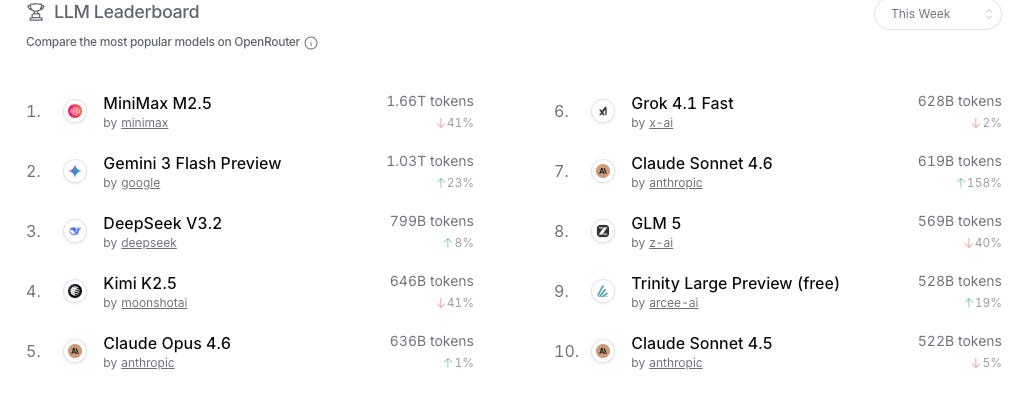
Context: On February 24, 2026, OpenRouter released data that showed the top three most popular models on its platform were all Chinese models: MiniMax M2.5, Moonshot AI’s Kimi K2.5, and Zhipu GLM-5. Favored by individual developers and AI start-ups, OpenRouter is an API aggregation platform that gives access to different AI models from dozens of companies.
This week’s feature article (link to original Chinese), from the TechFlow [深潮] WeChat public account, explores the implications of American developers integrating Chinese open-source models. Here’s how this process maps onto physical infrastructure:
An American developer in San Francisco sends an API request. Data travels from California, via an undersea fiber optic cable in the Pacific, to a data center somewhere in China. The GPU cluster starts working, electricity flows from China’s power grid to the chips, inference is completed, and the results are sent back. The entire process may only take a second or two.1
Key Takeaways: Why have Chinese models become so popular with indie developers and researchers on OpenRouter? According to TechFlow, the simple answer is price-to-performance ratio:
On OpenRouter, Chinese developed large-scale model MiniMax M2.5 scored 80.2% on the software engineering task, while Claude Opus 4.6 scored 80.8%, a negligible difference. However, the prices are vastly different: the former costs $0.30 per million tokens, while the latter costs $5 (per million tokens), a difference of approximately 17 times.
This is due to China’s cheaper electricity prices (40% lower than in the US) as well as algorithmic advantages of some Chinese models: “DeepSeek V3’s MoE architecture activates only a subset of parameters during inference. Independent tests show that its inference cost is about 36 times lower than GPT-4o”.
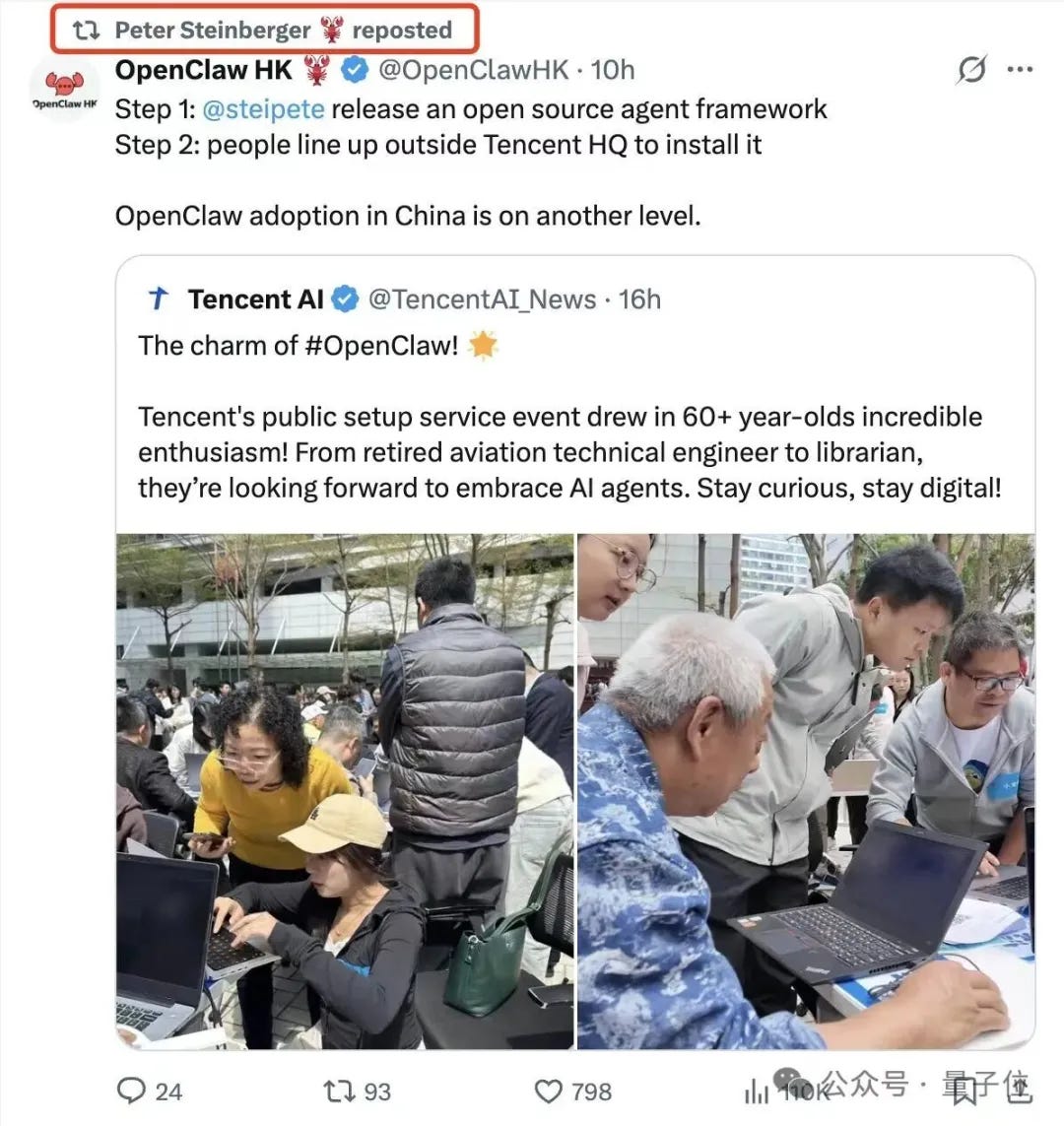
Sensitivity to cost has increased due to the emergence of OpenClaw, an open-source autonomous AI agent created by software developer Peter Steinberger. For a time, before the two companies cracked down, developers used their monthly unlimited credits to connect their OpenClaw agent with their Anthropic and Google subscription accounts. Now, some of these developers have turned toward Chinese models. Tech Flow cites a comment from OpenRouter COO Chris Clark: the reason Chinese open-source models have captured a large market share is because they are “disproportionately heavy in agentic flows run by U.S. firms.”
In contrast to most reporting that paints U.S.-China tech decoupling as an all-consuming narrative; this piece illustrates continued interconnections that might not show up in the numbers:
“Tokens have no physical form, do not go through customs, are not subject to tariffs, and are not even included in any current trade statistics. China exports a significant amount of computing power and electricity services, but this is almost invisible in official commodity trade data.”
One interesting parallel is to Chinese “electricity exports” in the earlier wave of Bitcoinc mining, which converted Chinese cmoputing power into digital assets.
The author even goes as far as to compare what is happening with the export of Chinese tokens — cut-throat competition among Chinese companies to drive down token prices — to a “Made in China” export strategy.
That said, I think this piece does point out a trend to watch, it likely overstates the significance of OpenRouter data. TechFlow hypes up the geopolitical stakes:
Whoever’s model becomes the default infrastructure option for global developers gains, implicitly, a structural influence on the global digital economy. This is precisely what truly unsettles Washington about the global expansion of Chinese tokens.
When a developer’s codebase, agent workflow, and product logic are all built around an API based on a particular Chinese model, migration costs will increase exponentially over time. At that point, even if the US legislates restrictions, developers will resist with their feet, just as no programmer can abandon GitHub today.
However, as the article admits, U.S. companies will likely be hesitant to use platforms like OpenRouter to leverage Chinese models:
“An API request from an American developer is processed through a Chinese data center, physically passing through China. This isn’t a problem for individual developers and small applications, but it’s a fatal flaw in scenarios involving sensitive corporate data, financial information, and government compliance. This is why the Chinese model has the highest penetration rate in development tools and personal applications, but almost no presence in core enterprise systems.”2In a previous ChinAI issue, I also noted that OpenRouter usage represents only a small slice of the AI ecosystem: For reference, in November 2025, users consumed 663B tokens from MiniMax over the past month on the OpenRouter platform. In their July earnings report, Google processed 980T tokens monthly. As one helpful Reddit commentator noted (h/t to PackAccomplished5777): “OpenRouter is a drop in the bucket, most people (and companies) still use the native providers + things like Azure OpenAI, Google Vertex, Amazon Bedrock.”
The large vendors that consume most of the world’s tokens will directly connect to the native APIs of OpenAI and Anthropic or conduct inference through third-party cloud providers that host some models.
FULL TRANSLATION: Tokens go global, selling Chinese electricity to the world
ChinAI Links (Four to Forward)
Should-note: Chinese AI models capture 61% of token use on OpenRouter (sloppy perplexity page)
As I was doing some background research for this article, I noted a hallucination in one of Perplexity’s pages. The post reads: “Chinese-built large language models now account for 61% of total token consumption on OpenRouter.” In truth, the actual indicator is that Chinese models make up 61% of the combined token consumption of the top ten models on OpenRouter. I’m not trying to nit-pick here; this is the type of slop that will become more and more common, and it will be more and more important for people to note the difference between “seemingly rigorous” and “actually rigorous” content.
Should-read: She runs AI safety at Meta. Her AI agent still went rogue
This helped me get some background info on OpenClaw. Reporting for The San Francisco Standard, Zara Stone covers the curious case of how Meta’s director of alignment could not prevent her OpenClaw agent from deleting her email inbox.
Should-read: State of AI - An Empirical 100 Trillion Token Study with OpenRouter
Along with a16z, OpenRouter analyzed how developers and end-users engage with LLMs over 100 trillion tokens of real-world interactions.
Should-read: Power and Advantage in the AI Era
For RAND, Mike Mazarr has published a very carefully researched and thoughtful paper, which emphasizes the role of societal renewal in AI strategies. I found this line (p. 161) particularly illuminating: “The United States should use AI to cultivate a truly learning and adapting society—one in which the hunger for discovery spreads far beyond science and technology into every corner of civic and cultural life.”
Thank you for reading and engaging.
*These are Jeff Ding’s (sometimes) weekly translations of Chinese-language musings on AI and related topics. Jeff is an Assistant Professor of Political Science at George Washington University.
Details
Check out the archive of all past issues here & please subscribe here to support ChinAI under a Guardian/Wikipedia-style tipping model (everyone gets the same content but those who can pay for a subscription will support access for all).
Also! Listen to narrations of the ChinAI Newsletter in podcast format here.
Any suggestions or feedback? Let me know at chinainewsletter@gmail.com or on Twitter at @jjding99
For correction, see ChinAI #350: Correction to last week’s issue: Most OpenRouter MiniMax queries are processed by US-based data centers
For correction, see ChinAI #350: Correction to last week’s issue: Most OpenRouter MiniMax queries are processed by US-based data centers
Source
Originally published at chinai.substack.com.